
Canine Training in Mumbai
- Home
- Canine Training
Mumbai's Complete Guide to Dog Training
Mumbai is a thriving metropolis with a vibrant pet community. The need for efficient dog training has increased as the number of dog owners continues to rise. You can choose the best way to care for your dog by using this guide, which will give you important insights into the different canine training options available in Mumbai.
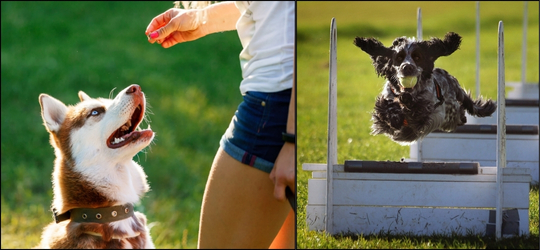
How Much Time Is Needed to Train a Dog?
How much time will my dog need to be trained?” It is never easy to respond to this question, which I get asked a lot by new dog owners. Proper dog training typically takes four to six months.
How long it might take to train a dog, however, depends on a number of factors. Is your goal to overcome a behavioral challenge or are you just teaching fundamentals? How much knowledge has the dog ever had? Has punishment or other aversive training methods been used in their prior training? Do these adults lack any prior training?
The most crucial factor to consider is how dedicated the people who are training are? In every situation, training a dog takes time, and the amount of time it takes depends as much on the humans training the dog as it does on the dog itself. In a few weeks, as a trainer, I might be able to teach your dog to sit, down, stay, and perform a basic recall; however, if you do not regularly reinforce those abilities, they will stay patchy and undeveloped.
We can not tell you how long it will take to train your dog, but we can give you some ideas about what might make it go more quickly or more slowly.
Dog Training Schedule: Success Suggestions
- Get all occupants of the home on board
It is especially important to get everyone in the home on the same page when it comes to teaching new skills and overcoming behavioral issues. To teach a dog, for instance, that jumping on people will not get them the attention they want, the human family members must consent to either turn around, go out the door, or leave if the dog jumps on them.
If everyone is on board, the dog will eventually discover that they can jump until the cows come home; if they do not alter their attention-seeking tactics, they will never get the attention they desire. Jumping will eventually die out (go away) and be replaced by more courteous requests—as long as those requests are being honored. The dog learns that the tactic occasionally works and has no reason not to give it up in favor of something more courteous if one family member decides to show them lots of attention whenever they jump up.
- Persistence over time is essential
Enforcing the training methods consistently over time is just as important as getting everyone in the household on board with them. Consider self-serving actions, such as leaping up to get attention or acting like your dog is a slot machine for affection. When Fido leaps up four times out of five, you ignore him until he presents you with a more appropriate option (like sitting at your feet or standing calmly with all four paws on the ground instead of jumping). However, the fifth time, you forget or become preoccupied and you give your dog your full attention when they jump. You might be willing to try your luck by playing a few games if the chances of winning at a slot machine were one in five.
The same calculation is made by your dog. Try it first before politely asking for attention if engaging in the enjoyable, natural behavior is rewarded one out of every five times.
- Creating a positive habit from scratch is more difficult than breaking a negative habit.
Have you ever made an effort to quit a negative habit? Let us say you smoke or bite your nails? If so, you are aware that forming a new routine is far less difficult than breaking a habit that has been practiced thousands, hundreds, or even thousands of times.
For our dogs, the same rules apply. It will always take less time to teach your dog a new skill than to try to alter their current relationship with a thing, someone, or an activity.
- It takes time for emotionally driven behaviors to change.
We can teach a basic beginning skill like sit or down with very little effort, depending on the dog. However, it takes time and effort to improve fear- or anxiety-based behaviors through training. We are attempting to address a deeply ingrained issue in your dog’s brain when we apply classical conditioning methods like desensitization and counterconditioning.
Consider attempting to get over your personal fear of anything that scares you, such as spiders, heights, small places, or anything else. Would one therapy session alter the way you react to these triggers? Ten sessions, how about it? Twenty meetings? It is impossible to find out. Teaching your dog to trust you and giving them the room they need to process their anxiety will be the only things that determine how quickly, if at all, the fear goes away.
- Your dog can only be trained at the rate that they can pick things up.
Each dog learns in a unique way. It really depends on the individual, not on maturity or genetics. Breed type and age can play a role occasionally—young, pliable dogs often pick things up quickly, as do working breeds. If you can teach your dog new skills in distraction-free, calm, and comfortable settings like your home, they will probably pick them up more quickly. Your dog may have trouble learning in general or with specific cues even under ideal circumstances. .
Make sure you are speaking clearly and going at a pace your dog can follow because a student’s ability to learn is frequently influenced by the quality of their teacher.
- Aversive training in the past may make it difficult for dogs to learn new skills.
Dogs that are subjected to traumatic training methods, such as prong collars or alpha rolling, may develop a lifelong fear of learning. It is frequently simple to identify dogs who have received this type of training in the past. Because they are afraid of what might happen if they make a mistake, they might be reluctant to follow lures. Because sharp noises used to indicate punishment, they could be alarmed by marker words or clickers. Because of their nervousness, they might find it difficult to focus or get too worked up during training.
To help these dogs overcome their fear of learning, additional time and attention should be given to them during training.
- Excellent incentives lead to excellent learning
Your dog will be more motivated to learn if you provide them with better rewards throughout training. For quicker responses, try high-value treats like tiny pieces of cheese, chicken, or hot dogs. Kibble and packaged treats are fine, too, though in some situations they might not even be effective.
- Training a dog is a never-ending process.
Canines and humans both never truly stop learning. Therefore, even after you have taught them a killer recall and a bombproof down-stay, their training is not over. Your dog will be intently observing you for cues about how to navigate their world for the duration of your relationship!
Trying to communicate in a way that encourages behaviors you like instead of ones you do not is your responsibility. You can make sure that your dog does not give up on the behaviors you have taught them because there is no benefit to them by continuing to reinforce the behaviors with rewards on a regular or even sporadic basis.
